This changes everything, p.1
This Changes Everything, page 1
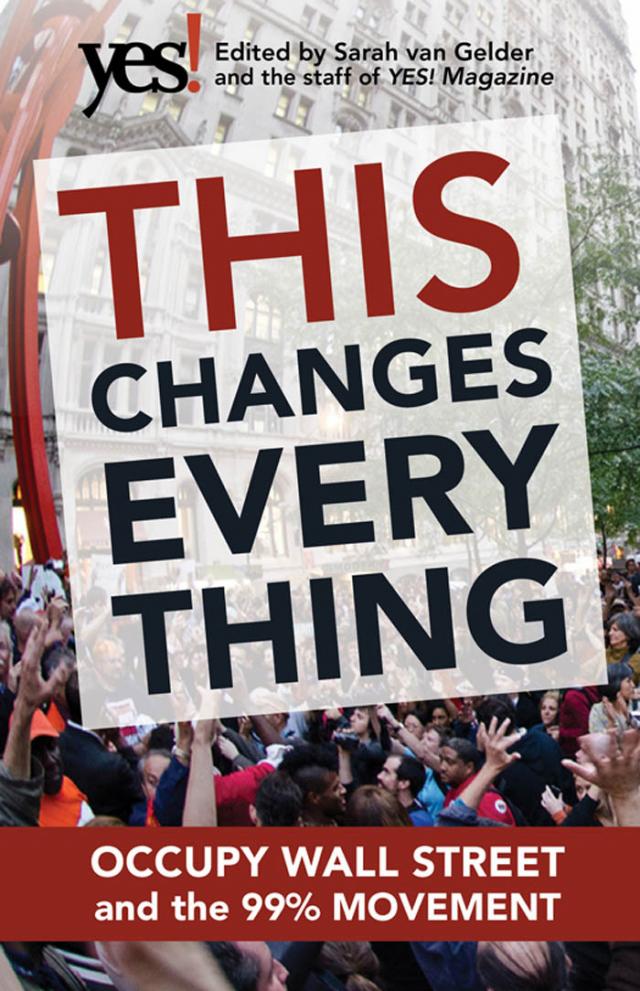


THIS CHANGES EVERYTHING
OCCUPY WALL STREET
and the 99% MOVEMENT
Edited by Sarah van Gelder
and the staff of YES! Magazine
This Changes Everything
Copyright © 2011 by The Positive Futures Network
All rights reserved. No part of this publication may be reproduced, distributed, or transmitted in any form or by any means, including photocopying, recording, or other electronic or mechanical methods, without the prior written permission of the publisher, except in the case of brief quotations embodied in critical reviews and certain other noncommercial uses permitted by copyright law. For permission requests, write to the publisher, addressed “Attention: Permissions Coordinator,” at the address below.
Berrett-Koehler Publishers, Inc.
235 Montgomery Street, Suite 650
San Francisco, California 94104-2916
Tel: (415) 288-0260, Fax: (415) 362-2512
www.bkconnection.com
Ordering information for print editions
Quantity sales. Special discounts are available on quantity purchases by corporations, associations, and others. For details, contact the “Special Sales Department” at the Berrett-Koehler address above.
Individual sales. Berrett-Koehler publications are available through most bookstores. They can also be ordered directly from Berrett-Koehler: Tel: (800) 929-2929; Fax: (802) 864-7626; www.bkconnection.com Orders for college textbook/course adoption use. Please contact Berrett-Koehler: Tel: (800) 929-2929; Fax: (802) 864-7626.
Orders by U.S. trade bookstores and wholesalers. Please contact Ingram Publisher Services, Tel: (800) 509-4887; Fax: (800) 838-1149; E-mail: customer.service@ingrampublisherservices.com; or visit www.ingrampublisherservices.com/Ordering for details about electronic ordering.
Berrett-Koehler and the BK logo are registered trademarks of Berrett-Koehler Publishers, Inc.
First Edition
Paperback print edition ISBN 978-1-60994-587-9
PDF e-book ISBN 978-1-60994-588-6
IDPF e-book ISBN 978-1-60994-589-3
2011-2
Cover design by Kelly Shea, assisted by Tracy Loeffelholz Dunn; interior design by Kelly Shea, based on a template by Valerie Brewster; copyediting on selected articles by James Trimarco; proofreading by Samantha Schuller; cover photo by Kurt Christensen; part I photo (page 14) by Brett Casper; part II photo (page 50) by Fran Korten; part III photo (page 68) by Brett Casper
This book is dedicated to the occupiers of Zuccotti Park, who challenged the Wall Street system on behalf of all of us, and to the thousands of people in other Occupy sites across the United States and the world. Your commitment to nonviolence, solidarity, justice, and a better world for the 99% has truly changed everything.
—the staff members of YES! Magazine
and Berrett-Koehler Publishers
Royalties from the sale of this book will go to support the Occupy Wall Street/99% movement; five hundred copies of the book will be distributed at no charge to Occupy sites.
CONTENTS
FOREWORD
Fran Korten
INTRODUCTION: HOW OCCUPY WALL STREET CHANGES EVERYTHING
Sarah van Gelder
10 WAYS THE OCCUPY MOVEMENT CHANGES EVERYTHING
PART I: OCCUPY WALL STREET
1. HOW OCCUPY WALL STREET REALLY GOT STARTED
Andy Kroll
2. ENACTING THE IMPOSSIBLE: Making Decisions by Consensus
David Graeber
3. PRINCIPLES OF SOLIDARITY
The Occupy Wall Street General Assembly
4. THE CHILLS OF POPULAR POWER: The First Month of Occupy Wall Street
Marina Sitrin
5. CLAIMING SPACE FOR DIVERSITY AT OCCUPY WALL STREET
Hena Ashraf
6. DECLARATION OF THE OCCUPATION OF NEW YORK CITY
The Occupy Wall Street General Assembly
7. NO LEADERS, NO VIOLENCE: What Diversity of Tactics Means for Occupy Wall Street
Nathan Schneider
8. THE MOST IMPORTANT THING IN THE WORLD
Naomi Klein
PART II: WHAT NEEDS TO CHANGE
9. HOW INEQUALITY POISONS SOCIETY AND EQUITY BENEFITS EVERYONE: An Interview with Richard Wilkinson
Brooke Jarvis
10. SIX WAYS TO LIBERATE MAIN STREET FROM WALL STREET
David Korten
11. A FAIR TAX SYSTEM: Three Places to Start
Chuck Collins
12. HOW TO CREATE LIVING-WAGE JOBS THAT ARE GOOD FOR THE PLANET
Sarah van Gelder and Doug Pibel
PART III: WE HAVE THE POWER
13. HOW TO PUT THE RIGHTS OF PEOPLE AND NATURE OVER CORPORATE RIGHTS
Thomas Linzey and Jeff Reifman
14. GOING TO THE STREETS TO GET THINGS DONE
Ralph Nader
15. THE OCCUPATION OF HOPE: Letter to a Dead Man
Rebecca Solnit
16. 10 WAYS TO SUPPORT THE OCCUPY MOVEMENT
Sarah van Gelder
About YES! Magazine
About Berrett-Koehler Publishers
FOREWORD
FRAN KORTEN
Late on Friday, October 7, 2011, I received an e-mail that set me on fire. It was from Steve Piersanti, president of Berrett-Koehler Publishers. He asked if YES! Magazine would be interested in publishing an “instant book” on Occupy Wall Street.
Since our founding in 1996, YES! Magazine has explored alternatives to corporate domination. We’ve covered efforts to create food justice, reform health care, build local economies, and solve the climate crisis. Our board chair (my husband), David Korten, has inspired us with deep insights on how to transform our economy. But time and again we’ve seen powerful interests associated with the 1% stop the needed changes.
So when a small group of activists began camping out in a park just blocks from Wall Street, we took notice. YES! editors Brooke Jarvis and Christa Hillstrom started posting articles on the movement. Steve commented that our coverage was the most thoughtful he had seen.
We were immediately taken with Steve’s idea of doing a book—and producing it fast. We found most media reports on the Occupy movement confusing or dismissive. By producing a book now we felt we could help the growing number of people interested in this movement understand its import. Staff at Berrett-Koehler, which has published many books on themes related to the movement, felt the same way.
Sarah van Gelder, executive editor of YES!, quickly assembled articles to 1) feature voices from inside and outside the movement, 2) spotlight changes capable of shifting our society’s wealth back to the 99%, and 3) show the power of social movements to bring about change. And then the production marathon began.
We decided to write in a voice that recognized that we, too, are part of the 99%. Staff members were spending time at Occupy Seattle. Susan Gleason and Sara Kirk were shipping copies of the “New Livelihoods” issue of YES! to Occupy groups. Sarah van Gelder was interviewed about the movement on PBS NewsHour. Staff were eager to donate book royalties to the movement. Berrett-Koehler offered five hundred copies of the book to distribute to Occupy sites.
We are grateful to the authors and photographers for their quick responses. At YES! Kelly Shea with help from Tracy Dunn designed the book. James Trimarco (who was on the ground in Zuccotti Park) provided valuable edits. Jessica Lind-Diamond, Christa Hillstrom, Derek Hoshiko, Rebecca Nyamidie, Ayla Harbin, Idil Levitas, Jennifer Kaye, Kate Malongowski, Dee Axelrod, Melinda Monroe, Connie Walton, Julie Katana, and Doug Pibel edited content and assured its accuracy. Samantha Schuller did final proofreading. Sharon Booth produced marketing copy. The YES! Magazine editorial team—Doug Pibel, Madeline Ostrander, Valerie Schloredt, and Tracy Dunn—produced our fifteenth anniversary edition on schedule despite the extra demands of this book. All the while, YES! staff and interns kept our programs running, including Rod Arakaki, Audrey Watson, Gretchen Wolf, Jing Fong, Michael Winter, Paula Murphy, Bridget McCarthy, and Neil Cresswell.
At Berrett-Koehler, Steve Piersanti provided wise guidance and unflagging enthusiasm on a daily basis. His colleagues were a dream to work with. Mike Crowley, Dianne Platner, Rick Wilson, Jeevan Sivasubramaniam, Kristen Frantz, Katie Sheehan, Cynthia Shannon, Marina Cook, Zoe Mackey, Courtney Schonfeld, David Marshall, Bonnie Kaufman, Johanna Vondeling, and other BK staff supported the design and production work, helped prepare and disseminate marketing materials, and arranged distribution through many different channels.
I am deeply grateful for the millions who are dedicated to transforming our societies to benefit the 99%. And I feel blessed to work with a remarkable team so ready to bring forth a positive vision of the possibilities that lie ahead.
Bainbridge Island, Washington
October 31, 2011
Fran Korten is the publisher of YES! Magazine.
INTRODUCTION:
HOW OCCUPY WALL STREET
CHANGES EVERYTHING
SARAH VAN GELDER
“We fail to understand why we should have to pay the costs of the crisis, while its instigators continue to post record profits. We’re sick and tired of one injustice after another. We want human dignity back again.
This isn’t the kind of world we want to live in, and it’s we who have to decide what world we do want. We know we can change it, and we’re having a great time going about it.”
From #HowToCamp by the Spanish indignados, whose occupations in cities throughout Spain helped inspire Occupy Wall Street
Inspired by the Arab Spring and uprisings in Europe, sparked by a challenge from Adbusters magazine to show up at Wall Street on September 17 and “bring a tent,” and encouraged by veteran New York activists, a few thousand people gathered in the financial district of New York City. At the end of the day, some of them set up camp in Zuccotti Park and started what became a national—and now international—movement.
The Occupy movement, as it has come to be called, named the source of the crises of our time: Wall Street banks, big corporations, and others among the 1% are claiming the world’s wealth for themselves at the expense of the 99% and having their way with our governments. This is a truth that political insiders and the media had avoided, even while the assets of the top 1% reached levels not seen since the 1920s. But now that this genie is out of the bottle, it can’t easily be put back in.
Without offices, paid staff, or a bank account, Occupy Wall Street quickly spread beyond New York. People gathered in Boston, Chicago, Los Angeles, Portland, Atlanta, San Diego, and hundreds of other cities around the United States and claimed the right of we the people to create a world that works for the 99%. In a matter of weeks, the occupations and protests had spread worldwide, to over 1,500 cities, from Madrid to Cape Town and from Buenos Aires to Hong Kong, involving hundreds of thousands of people.
The Occupy Wall Street movement is not just demanding change. It is also transforming how we, the 99%, see ourselves. The shame many of us felt when we couldn’t find a job, pay down our debts, or keep our home is being replaced by a political awakening. Millions now recognize that we are not to blame for a weak economy, for a subprime mortgage meltdown, or for a tax system that favors the wealthy but bankrupts the government. The 99% are coming to see that we are collateral damage in an all-out effort by the super-rich to get even richer.
Now that we see the issue clearly—and now that we see how many others are in the same boat—we can envision a new role for ourselves. We will no longer be isolated and powerless. We can hold vigils all night when necessary and nonviolently face down police. We are the vast majority of the population and, once we get active, we cannot be ignored. Our leaders will not fix things for us; we’ll have to do that ourselves. We’ll have to make the decisions, too. And we’ll have to take care of one another—provide the food, shelter, protection, and support needed to make it through long occupations, bad weather, and the hard work of finding consensus when we disagree.
By naming the issue, the movement has changed the political discourse. No longer can the interests of the 99% be ignored. The movement has unleashed the political power of millions and issued an open invitation to everyone to be part of creating a new world.
Historians may look back at September 2011 as the time when the 99% awoke, named our crisis, and faced the reality that none of our leaders are going to solve it. This is the moment when we realized we would have to act for ourselves.
The Truth is Out: The System is Rigged in Favor of the Wealthy
One of the signs at the Occupy Seattle protest reads: “Dear 1%. We were asleep. Now we’ve woken up. Signed, the 99%.”
This sign captures the feeling of many in the Occupy movement. We are seeing our ways of life, our aspirations, and our security slip away—not because we have been lazy or undisciplined, or lacked intelligence and motivation, but because the wealthiest among us have rigged the system to enhance their own power and wealth at the expense of everyone else.
Critics of the movement say they oppose the redistribution of wealth on principle. But redistribution is exactly what has been happening for decades. Today’s economy redistributes wealth from the poor and middle class to those at the top. The income of the top 1% grew 275 percent between 1979 and 2007, according to the Congressional Budget Office. For those in the bottom 20 percent, income grew just 18 percent during those twenty-eight years.
The government actively facilitates this concentration of wealth through tax breaks for corporations and the wealthy, and bailouts for giant banks and corporations. These entities also benefit from mining rights, logging rights, airwave rights, and countless other licenses to use common assets for private profit. Corporations shift the costs of environmental damage to the public and pocket the profits. Taxpayers bear the risk of global financial speculation while the payoffs go to those most effective at gaming the system. Instead of investing profits to provide jobs and produce needed goods and services, the 1% put their wealth into mergers, acquisitions, and more speculation.
The list of government interventions on behalf of the 1% goes on and on: Tax breaks favor the wealthy, global trade agreements encourage offshoring jobs, agricultural subsidies favor agribusiness over family farms, corporate media get sanctioned monopolies while independent media gets squeezed.
The people who go to work producing things we need—the middle class and working poor—pay the price for all this. Speculative profits act as a drain on the economy—like a hidden tax. This hidden tax is one of the many reasons the middle-class standard of living has been slipping.
This lopsided division of wealth corrupts government. Few among the 99% now believe government works for their benefit—and for good reason. With the 1% commanding an army of lobbyists and doling out money from multimillion-dollar campaign war chests, government has become a source of protection and subsidies for Wall Street. No wonder there isn’t enough money left over for education, repairing roads and bridges, taking care of veterans and retirees, much less for the critical transition we need to make to a clean energy future.
The system is broken in so many ways that it’s dizzying to try to name them all. This is part of the reason why the Occupy movement hasn’t created a list of demands. The problem is everywhere and looks different from every point of view. The one thing the protesters all seem to agree on is that the middle-class way of life is moving out of reach. Talk to people at any of the Occupy sites and you’ll hear stories of people who play by the rules, work long hours, study hard, and then find only low-wage jobs, often without health care coverage or prospects for a secure future.
And many can find no job at all. In the United States, twenty-five million people are unemployed, underemployed or have given up looking for work. Forty-five percent of those without jobs have been unemployed for more than twenty-seven weeks. Some employers won’t hire anyone who is currently unemployed. Meanwhile, the cost of health care, education, rent, food, and energy continues to rise; the only thing that’s falling is the value of homes and retirement funds.
Behind these statistics are real people. Since the Occupy movement began, some who identify themselves as part of the 99% have been posting their stories at wearethe99percent.tumblr.com. Here’s one: “I am a lucky one. I have enough money to eat three of four weeks of the month. I have been paying student loans for fifteen years and still no dent. My husband lost his job...Last year I took a 10 percent pay cut to ‘do my share’ and keep layoffs at bay. I lost my house. I went bankrupt. I still am paying over one thousand dollars in student loans for myself and my husband and that is just interest. We will not have children. How could we when we can’t even feed ourselves? I am the 99%.”
Another personal story, by a sixty-year-old, reads, “Got laid off. Moved two thousand miles for new job. Pays 40 percent less than old job. Sold home at a loss. Filed Chapter Eleven. Owe IRS fifty thousand dollars. Fifteen thousand dollar per year debt for son’s tuition at state university. Seventy-five percent of retirement funds shifted to the 1%! I am the 99%!”
The Web site contains thousands of stories like these.
Now that we know we are not alone, we are less likely to blame ourselves when things are hard. And now that we are seeing the ways the system is rigged against us, we can join with others to demand changes that will allow everyone to thrive.
We the People Now Know That We Have the Right, and the Power
The power of the Occupy Wall Street movement is rippling out far beyond the people camped at Zuccotti Park in lower Manhattan, and even beyond the occupation sites springing up in cities around the world. This movement is reaching people who are carrying a protest sign for the first time, including some conservatives, along with union members who have been fighting a losing battle to maintain their standard of living.