

Flurb 13, p.1
FLURB #13, page 1
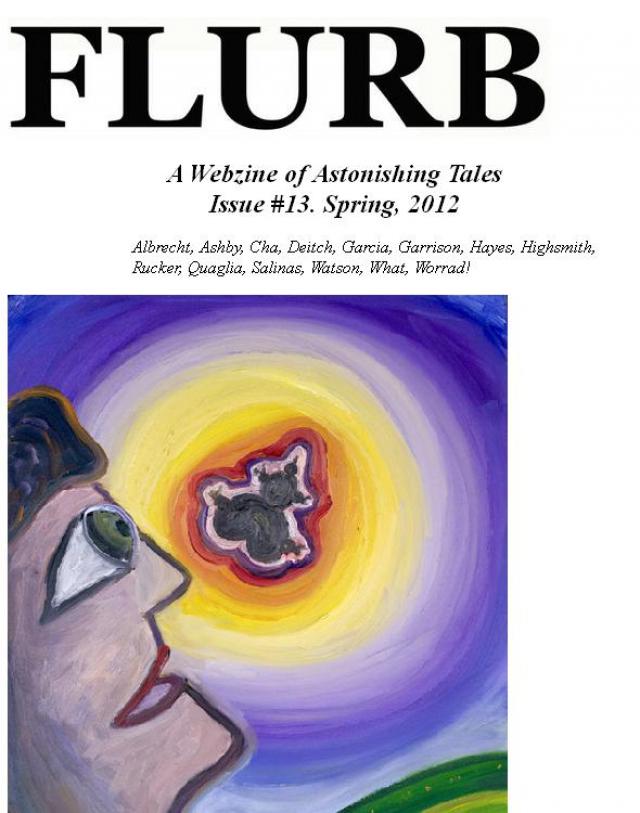


A Webzine of Astonishing Tales
Issue #13. Spring, 2012
Albrecht, Ashby, Cha, Deitch, Garcia, Garrison, Hayes, Highsmith, Rucker, Quaglia, Salinas, Watson, What, Worrad!
Issue #13 Contents:
Editor's Introduction
Rudy Rucker
Jane and the Roadspider
James Worrad
Eye-High
Seth Kallan Deitch
The Gaon of Chozzerai
Leslie What
Counter
William Highsmith
Journey to the Center of the Flat Earth
Ian Watson & Roberto Quaglia
The Invention of Beloved Money
Madeline Ashby
Give Granny a Kiss
Martin Hayes
A Bigger Piece of Nothing
A. S. Salinas
Lohengrin & Tanhauser
Wongoon Cha
Procrastination
Andy Albrecht
Sea Change
Rudy Ch. Garcia
Last Call for Ice Cream
Brian Garrison
Five Poems
Editor's Introduction
March 23, 2012
We've got thirteen pieces for the thirteenth issue of Flurb. This was an especially enjoyable issue for me, and it might be the best issue yet. I received a number of excellent stories from beginning writers, and they were eager to work with me on amping their stories to a very high level.
My story, "Jane and the Roadspider," is a love story set in that transitional time—around the end of this century—when we'll be replacing most of our machines with biotweaked plants and animals. I enjoyed placing the story in Louisville, Kentucky, where I grew up, and where my brother still lives.
James Worrad's "Eye-High," is a high-speed freaks-meet-aliens blast, with a cyberpunk flavor, and a delicious twist at the end. The story is shimmery and it glows.
Seth Deitch brings in a solid Golden-Age-style tale, "The Gaon of Chozzerai." This is the kind of story that drew me into SF in the first place. Initially I'd thought the title was in some warped language—I thought of the classic tale title, "The Oofth of Ifth." The actual explanation is funnier. Deitch comes up with a great science twist for his sense-of-wonder tale, and a haunting evocation of the ultimate library and museum complex that one dreams of.
Leslie What is back in Flurb, with "Counter." It's not science-fiction or fantasy, but it's a disorienting glimpse into an off-kilter mind. Very evocative and moving. I thought about it for days after I read it.
When I saw the title of William Highsmith's "Journey to the Center of the Flat Earth," I pretty much knew I'd want to run it. Highsmith lives up to the title's promise, and brings off a strong riff on Jules Verne's classic novel, with intriguing metadisorientation at the end.
Yes, Ian Watson and Roberto Quaglia are nasty old men. But funny ones. I suffered through some airport security procedures last week, and it cheered me to chuckle (inwardly) about Watson and Quaglia's conceit that the airport check-in ordeal may soon include a stop at an enema hut. Their story's ruminations on the nature of money are clever and thought-provoking—despite the fact that, being far-out writers, these transgressive sages have little direct experience with cash.
Madeline Ashby makes her fourth appearance in Flurb, sharing the prologue of her forthcoming novel vN. "vN" stands for von Neumann, and the stand-alone "Give Granny a Kiss" is about androids living as people. It's a familiar theme, but Ashby makes it intense and emotionally real. She piles on an escalating series of shocks, and after the tale's frenzied denouement, I felt a little afraid of Madeline's seemingly agreeable photo at the end.
Martin Hayes, a Flurb third-timer, treats us to an evocative and archetypal UFO tale. Are the saucers really coming? Enter "A Bigger Piece of Nothing" and see the big aha.
The redoubtable A. S. Salinas returns to Flurb with "Lohengrin & Tanhauser," another of his Flash-Gordon-meets-William-Burroughs extravaganzas, overflowing with eyeball kicks, gently psychedelic, and gilded with touches of Futurama fun.
The new writer Wongoon Cha mixes visions of Oakland and Seoul to cook up "Procrastination," a great adventure in a city infested by giant beetles. Are they evil invaders, huntable game, or cosmic mentors? Do your homework.
Andy Albrecht, another beginning writer, has written a gripping story about a pair of Beavis-and-Butthead-type no-goods who get mixed up with a by-no-means benevolent alien. To kick his story up a notch, Albrecht uses the cool pomo move of sampling in material from a mass-market tale of alien terror. A heady mix.
Rudy Garcia's "Last Call for Ice Cream" is a hypnotic stew of spanglo slanguage, wry and funny, with a special surprise in every sentence, and a renegade view of life in these United States.
We close with SFnal poet Brian Garrison's return to Flurb. Lovely stuff, Brian. Pure energy for the mainbrain.
***
I've loved putting together these thirteen issues of Flurb. Getting my pro friends to unveil their more outré works is a kick, and working with new writers enlivens the field. Flurb's been well received, and like to think it's had a good effect on the on-going evolution of modern speculative fiction.
As I mentioned above, I feel like issue #13 is a high point, an apotheosis for Flurb, and I'm not sure I can do a better one. Having reached this point, and with publishing in such a state of change, I'm not sure if or when I'll be putting together an issue #14, or what form it might take.
When I have a clearer idea about Flurb's future, I'll post the info on this page. And if you haven't heard anything by fall, 2012, you might direct Flurb inquiries to editor at flurb dot net.
***
Be that as it may, if you enjoy the pieces in our current issue #13, please favor us with a friendly remark at the comments link. Our authors need and deserve your praise.
—Rudy Rucker
==============================
Post an online comment about issue #13.
==============================
Visit Flurb online at www.flurb.net.
==============================
* Flurb is Hosted by Monkeybrains.net
==============================
* Flurb is Sponsored by Transreal Books
==============================
Jane and the Roadspider
by Rudy Rucker
Story Copyright (C) 2012, Rudy Rucker.
Images Copyright (C) 2012, Rudy Rucker.
4,200 Words.
I’d known Jane Roller my whole life—all the way back into the fog and shadows of early childhood. My parents, though not nearly as well-off as the Rollers, were in their circle of friends.
I was an only child. Dad was a society painter, turning out landscapes of country mansions and portraits of the elite who lived within. He wasn’t above painting bird dogs and thoroughbred horses as well. Mom was a wedding planner, with a sideline in floral arrangements. I attended the private St. Francis school east of Louisville amid the horse farms—as did Jane Roller. We were in the same grade.
Jane had remarkable hair—more than blonde, it was yellow with a tinge of red. She’d get flushed and shiny when she was feeling lively, which was often. She had a flexible voice—jolly, outraged, defiant, conspiratorial, amused—and she liked to talk in accents. Not that, in the earliest days, I paid much attention to her. The boys played with the boys, the girls with the girls.
Jane’s parents owned a downtown company that made feed for livestock. When I was about four years old, they switched to making food for nurbs—the wetware-programmed plants and animals that people were starting to use.
I remember my mother showing me what she called a bouquet reef. It was something she’d purchased for spare-no-expense reception. The bottom of the bouquet reef looked like a log, and pale, flexible blossoms were growing out of it—an amazing array, approximately like white roses, creamy tulips, and calla lilies.
“They’re not really flowers,” Mom told me. “They’re nurbs. More like animals than like plants. Here, you can have one.” She uprooted a lily, bringing a bit of the crumbly log-thing with it. The lily wailed in protest, lashing back and forth.
I’d been hearing talk about nurbs, but in the outskirts of Louisville this was the first nurb I’d actually seen. I was greatly intrigued. I took the lively lily to my room, and for a few days she was my pet. I fed her sips of water and crumbs of what Mom called nurb chow.
“It’s made by our good friends the Rollers!” Mom told me. “You know Jane. The chow has tobacco in it. That way the nurbs get hooked, and we humans can keep the upper hand.”
One of my big memories of Jane dates from when I was twelve. The cool kids from St. Francis were at the house of one of Jane’s friends—we were taking a run at having a teenage party. Jane and her girlfriends huddled together, whispering, and then two of the friends ran over and grabbed me by the hands.
“Seven minutes in heaven,” they cried, all but choking on their glee. “Jane Roller and Morton Plant!”
They shoved Jane and me into a dark coat closet and slammed the door.
“Well?” said Jane, standing very close to me. Some of the coats were nurbs, and they were twitching. In the dark, I imagined that I could see Jane’s voice. It was a short length of wide gold ribbon with a filigree at one end.
“What?” I said. I didn’t actually talk with Jane very often. It was more like we just happened to bounce off each other now and then.
“Kiss!” yelled the two giggling girls outside the closet door. “Morton and Janie in the closet tree! K-I-S-S-I-N-G! One minute gone, six to beeee!”
“We can kiss, yes,” said Jane, pecking me on the mouth. At first I held my lips stiff, but quickly I learned to make them soft, and even to poke my tongue into Jane’s mouth. A flat, neutral taste, not unpleasant.
I didn’t know where to put my hands, so I wrapped my arms around her. A hug. Close up, she smelled like honeysuckle vines and like salt. Time seemed to stop. My penis was stiff. I hoped Jane didn’t notice it bumping against her through our clothes. And at the same time I hoped she did.
Loud thumping on the closet door.
“Lovebirds forevva,” said Jane lightly. The door opened, her girlfriends shrieked, the world rolled on.
Heedless as boys tend to be, I pretty much forgot about the seven minutes in heaven and went back to my ordinary life. It never occurred to me to try and orchestrate a second tryst with Jane. Her parents were so much richer than mine. And it seemed like she was mostly going around with boys from the upper grades at school.
Senior year in high-school, some of the kids were talking about going to college, but that scene wasn’t like in the old days. Not many people did college at all anymore.
Sure, there was still a winged-ants-mating-flight aspect to higher education. It was a way to find lovers, friends, and future business contacts. But by now we all had squidskin wrist patches—and we made a lot of our social connections via the web. When we wanted to go out, the web guided us to flash parties with friends or with friends of friends.
As for learning things, sure colleges had some intense courses. But the courses were online as well—if you had the patience to channel them, not that many of us did. Mostly you could get by with grabbing piecemeal info off the web. And whatever you forgot, you could look up again.
I ended my family’s worries about the expense of upper-crust schools and told Mom and Dad I wasn’t going there. They were relieved—for about ten minutes. Then they they switched to worrying about me finding a career.
Mom suggested that I might help her with the wedding catering. I was, after all, good with the sometimes capricious nurbs. And I had the gift of empathy. People always liked me. But no, working my friends’ weddings wasn’t a row I wanted to hoe.
“Be an artist with me,” said Dad. “We can do the traditional thing. Plant the Elder and Plant the Younger. Louisville’s high-society art dynasty. You draw so beautifully, Mort. You have a vibrant, living line.”
“Thanks, Dad. But what did you see me draw lately?”
He was a little embarrassed. “Well, you know. Every once in awhile I cruise the social webs. I did a search for you, and I saw some sketches. Like that one of your friend Carlos fooling around with a squidskin on his back? And the one of that girl you’ve been seeing—Reba Ranchtree? Drawn from life? Powerful work.”
“Reba liked her picture too,” I allowed. “It upped her sexability rank.”
“What if, just to start with, you take some of my horse and dog commissions?” suggested Dad. Catching the look on my face, he added, “And paint some of the estates as well. They’re fun. But it’ll but awhile until you can handle the portraits.” He smiled softly. “These wealthy women—they’re very sensitive, very particular in their needs.”
“I bet,” I said. There was an unspoken suspicion around our house that my father was seducing his tastier clients. But Mom wasn’t pressing the issue. I had the feeling she was up to something herself.
These weren’t topics I liked to dwell upon. Indeed, I had a phobia that I’d eventually surf into a video of Mom or Dad in action, eyes bright and features engorged. Ugh. Not that, by now, anyone was particularly shocked by scabrous revelations on the web—what with all the pinhead cameras around. Everyone cursed, everyone drank, everyone shit, everyone fucked, and most of it was online 24/7. Privacy was gone, and we’d gotten over it. You couldn’t bust people for the little human foibles anymore.
Anyway, I took up Dad up on his offer and began working in his studio after school—and when school ended, I stayed on for another three years. Sure I was eager to leave home and to be an artist on my own. But for now, I could still learn from the old duffer. And he was getting me gigs. And he had a primo stash of art supplies.
Mostly Dad and I got along pretty well. But we reached a parting of the ways when I got hold of some nurb paint.
This product was designed to put patterns onto old-fashioned plaster walls, or onto the bodies of the electric cars that people were still using. Rather than being a high-priced squidskin, the nurb paint came in buckets like house paint. It was alive, and it was based on three cultures of slime mold, each mold with its own inherent color—red, yellow, blue. The living paint understood a vocabulary of a few hundred words—what you might call a programming language.
Once you’d slathered the stuff onto a wall it could form stripes, polka-dots, nested scrolls, branching filigrees or, if you were into sampling, a copy of some particular image. Given that the nurb paint layer was several millimeters thick, you also had the option of coaxing it to wrinkle up and form embossed patterns. You could talk to it, and you could push it around with a brush.
Quickly I mastered the nurb paint interface. I sensed this new medium could be richly expressive. In a few days I was painting vibrant little landscape studies—bedecked with thorns, elephant trunks, and puckers like the faces of little gnomes. And by the end of March, I had a large finished piece that I really liked.
Dad was dubious, and when I told him he should switch to the new stuff too, he exploded. “I want your creepy-crawly crap out of my studio,” he yelled, his long hair flying from side to side. “It’s evil! Use the good things I taught you, Morton. Go back to the oil paint.”
“That’ll be a cold day in hell,” I said. In silence I began packing up the easel, brushes and canvases that I’d bummed off Dad—also my cans of nurb paint.
Just then one of Dad’s clients happened to meander in—Todd Trask, a social butterfly who owned a Derby-winning thoroughbred. He lived as a bachelor in an old, exquisitely outfitted mansion on his horse farm overlooking the Ohio River. He had an amusingly campy accent—the man was a fop, a dandy, a nob. I greatly enjoyed it whenever my family and I were invited to his extravagant dos.
“I’ve got my portrait of your friend Jason all set,” Dad told Todd.
“Yes, yeees,” said Todd, ignoring Dad and focusing on me. “The hale apprentice in the master’s workshop. Greetings, Morton. This exultant blare of shape and color is from your brush? Hmmm. I’m thinking it involves the new nurb paint I’ve been hearing about? Most excellent.” Todd leaned in close to my large canvas. He smelled of lavender and country ham. “One might fear a cheap, generic effect, but you’ve made it elegant. Polyrhythms, chaoticity, gnarl. Very of-the-moment. I see a nightmare horse, a crowd in motion, and—how sardonic—fat snails on the track. Une belle bizarrie. What do you call your—your monsterpiece, Morton?”
“Cold Day in Hell,” I said, giving Dad a cocky grin. “That’s the title I’m using for this series. Each painting has a subtitle too.” Gauging Trask’s interests, I came up with a good one. “Cold Day in Hell: Derby Day Winner’s Circle.”
“I shall have it!” cried our mark. “Name your price.”
Dad got in on the conversation then. He knew much more about the business side of art than I did. If I was actually going to sell my outrageous new work, Dad wanted to be on my side. And, as he’d later put it, so what if he didn’t like the taint of my paint. He’d been wrong about art fads before. Come what may, we Plants were a team.
Todd, Dad and I tossed around some numbers, and then I hit on a different kind of deal. “I’m just about ready to move out on my own,” I told Todd. “I’m getting serious about my work, and I’ll need my own studio. Would—would you have something like a spare tenant’s house that I could use rent-free for a couple of years? And a car?”
“How about a grown home and a roadspider!” exclaimed Todd. “Yes, yes! An outsider nurb artist. Adding buzz to the Trask name. Hail the patron! How Florentine. Can you promise me first bid on your next few works?”
“He’ll be selling through Idi Did’s gallery,” put in Dad, smooth as silk. “And she’ll set the prices. Certainly Idi can give a right of first refusal, Todd. But what’s a roadspider?”






