

Double eagle, p.1
Double Eagle, page 1


The Home of Great
Western Fiction
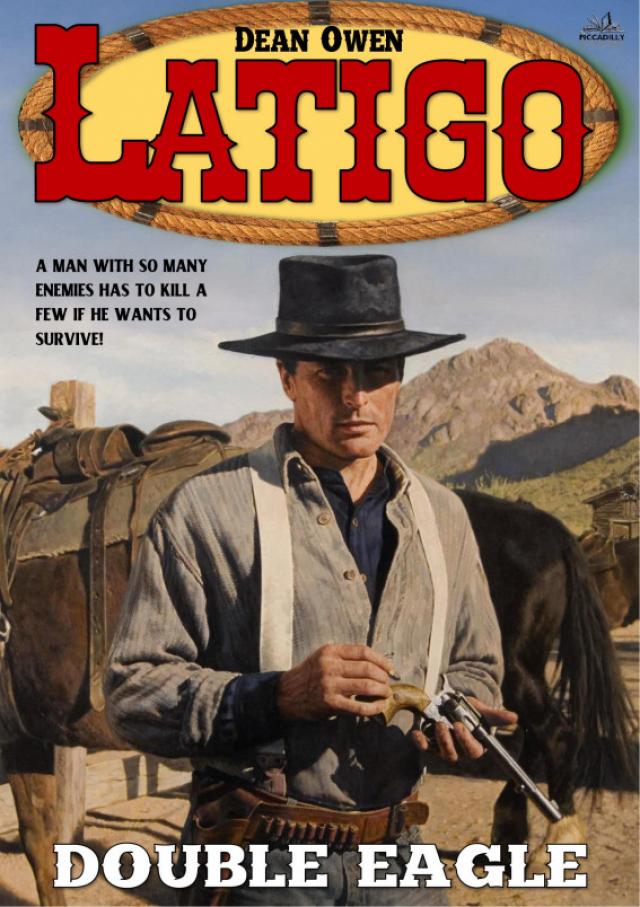
Three ugly bushwhackers were terrorizing Cole Cantrell’s friends into selling out to the railroad. Claudius Max, the vicious sonofabitch who owned the railroad, was backing them up. He was also the man who had killed Cantrell’s parents. Then there was Max’s latest hired gun, the smooth killer August Pyne.
Max figured Cantrell—better-known as Latigo—was finished.
But Cantrell had his friends too. Trouble was, most of them were women who wanted him to spend the rest of his days in their beds.
So when it came to facing the most violent men in the West, Cantrell was on his own.
And nobody knew that better than he did.
LATIGO 4: DOUBLE EAGLE
By Dean Owen
Based on LATIGO, the cartoon strip by Stan Lynde.
First published by Fawcett Popular Library in 1982
Copyright © 1982, 2024 by Dean Owen
This electronic edition published February 2024
Names, characters and incidents in this book are fictional, and any resemblance to actual events, locales, organizations, or persons living or dead is purely coincidental.
You may not copy, store, distribute, transmit, reproduce or otherwise make available this publication (or any part of it) in any form, or by means (electronic, digital, optical, photocopying, recording or otherwise), without the prior written permission of the publisher. Any person who does any unauthorized act in relation to this publication may be liable to criminal prosecution and civil claims for damages.
This is a Piccadilly Publishing Book
Text © Piccadilly Publishing
Editor: Ben Bridges
Published by Arrangement with the Golden West Literary Agency.
Visit www.piccadillypublishing.org to read more about our books.
Chapter One
COLE SAW THE dead man, heard the coarse laughter. He had just ridden through the main gate of the stockade, not rating a salute as in former times. A dusting of afternoon snow on the parade ground had already been trampled by boots and hooves.
He swung long legs out of the saddle. For the first time in hours his feet struck solid ground. He stared in disbelief at the dead man, a Sioux brave flung carelessly like discarded clothing onto a bank of snow beside, one of the log walls. Next to the body a group of white men in greatcoats, rifles under their arms, talked and laughed among themselves. Cole didn’t have to be told they were professional hunters.
Their laughter drove deep in him like a wasp sting. It drove the chill and tiredness from his backbone. He started walking purposely toward the group of white civilians.
Sergeant Muldoon, square-faced and towering, hurried to try to intercept him. “Easy, lad. They never shoulda brung the dead one into the fort …”
Cole walked away from the restraining hand. “Why was the Indian killed?” Cole demanded of a bearded man who had been laughing louder than the others.
“He got in our way, is why.” Whiskey breath and arrogant eyes beat against Cole’s brown face. “An’ who the hell are you to be askin’ questions?”
“Cole Cantrell, chief of scouts.”
The group of men suddenly quieted and the voice of the bearded man was almost respectful. “The one they call … Latigo.”
One of the men, chewing a pipestem with yellowed teeth, explained about the Indian. They had run into a herd of buffalo on the move. “Injun took a shot at us. Figured the major would want a look at what we kilt, so we …”
“I see.” Cole marched stiff-legged toward headquarters, Muldoon hurrying to catch up. Muldoon tried to get him to cool off by explaining what had happened while Cole had been at the Sioux encampment forty miles east. But the dismal story did not improve Cole’s mood in the waning day. One stupid gunshot and all his good work could be undone. After hours of parley that culminated in the smoking of the pipe, he had hurried back to the fort through mud and late snows. It was urgent that he report the chiefs had finally agreed to let the major speak to them of peace—only because Cole’s persistence had beaten through suspicion and in some cases outright hatred.
As chief of scouts, Cole had hoped he and a cadre of cool heads in the military might be able to minimize further bloodshed. Major Landeau was obviously stiff-necked in his hatreds and determined to pursue his own policy.
Cole barged into Landeau’s quarters, ignoring the orderly out front. Landeau was behind his desk.
“You waited till my back was turned, then brought in professional hunters!” Cole charged.
“By what right do you come storming in here, Mr. Cantrell?” Landeau glared at the tall man with the piercing black eyes, the aquiline nose, wide mouth, and hard jaw. “I have a new assignment for you.”
Cole, trying to curb his temper, said, “Just when I got the chiefs to agree to at least listen to you, hunters kill one of their people.”
“Your idea for that parley, not mine!” Landeau’s small fingers gripped the edge of his desk. His blue uniform with gold insignia was freshly pressed. “As for the Indian, he fired on the hunters. They have a right to protect themselves.”
“Two dozen men against one,” Cole snapped.
“Certain officers,” Landeau said with a curl of lips, “insisted your white blood would prevail when it came to a decision between whites and those savages. I knew they were wrong.”
“The buffalo are already dwindling,” said Cole heatedly. “Is starving the Indian what you want?”
“Empty bellies make them easier to handle.”
Cole ground his teeth. It was fools such as Major Landeau who had scoffed when veteran horse soldiers proclaimed the finest light cavalry in the world to be Indian. Casualties and humiliation at the hands of the mobile and deadly fighting force finally convinced them. But instead of trying to make peace on honorable terms, Landeau and others of his ilk were determined that what couldn’t be accomplished by light horse cavalry would be done by famine.
“Cantrell, you were hired as a scout,” the major said coldly, “not as my adviser on Indian affairs.”
“Sir, all I’m trying to do is head off bloodshed.”
“I should never have allowed myself to be talked into accepting a half-breed in my command.”
Cole bristled. “My Crow blood helps me understand the Indian.”
“Your new assignment. I’m sending you up the Missouri.”
“To do what?” Cole demanded narrowly.
“Blink at the stars. Draw rations for thirty days.”
“And by the time I get back there’ll be at least four thousand slaughtered buffalo.”
“You question my orders?”
“I am, because you’re blind to—”
“Then get the hell off this post!”
“With pleasure, sir!”
When Cole Cantrell had stormed out of the room, past a white-faced orderly, Landeau finally got himself under control. He thought of a man who would be interested to learn that Cantrell was no longer chief of scouts. Last fall in New Sodom, Landeau had met Claudius Max. Landeau would write Max the good news.
“That should warm his iron heart.” Landeau knew it couldn’t hurt to remain on friendly terms with the most powerful man in the West.
Several days before Cole’s separation from the military, his name was on the mind of Claudius Max. Max, in his office in the Python Building in Basin City, curbed his frustration because his nemesis, Cole Cantrell, seemed out of reach, under military protection as chief of scouts at Fort Savage. But the fort was far to the north, and Max in his grab for power felt he could safely move against a lesser enemy. He paced heavily about his office, ornate by frontier standards, while turning the matter over in his mind. A lingering winter had caused further delay in the laying of tracks for a northern line of his Centurion-Pacific Railroad. That meant another year before the line could be completed and new territory opened.
Meanwhile the gap could be bridged by stagecoach. And in this part of the country it meant Intermountain. Cantrell had been superintendent of the line before taking the job at Fort Savage. Once before, Max had been on the verge of acquiring the stage line owned by Martin Gale, but had been thwarted by Cantrell.
Not this time, Max vowed. Intermountain in addition to his railroad would give him a choke hold on transportation. Max beamed at the bust of a conqueror that reposed on his large flat-topped desk. “We Caesars always triumph in the end …”
Max called in the new man who had been waiting for him in the outer office. It was distasteful having to deal with such ruffians as Brad Deal. But in the West there was no choice if one wanted dangerous business done.
Max waved the big, lumbering man to a chair, then mentioned that Martin Gale had temporarily moved the main office of his stage line to Eden. “Deal, your job is to incapacitate him.”
Deal ran a hand over his stringy black hair and frowned over the word. He eyed his employer, who overflowed a leather chair behind the desk. Max, though short in stature for his height, was disproportionately wide through the body. At times the round face with its steel-blue eyes, the dewlaps, could be almost cherubic. Mostly it was demonic.
Max explained what he meant by “incapacitated” and bit back irritation at the fool’s ignorance. “I want him to be able to hold a pen and sign his name, however.”
“I’ll just make him bleed a little.”
“Above all, I don’t want him dead.”
“I always follow orders, Mr. Max.” Deal thumped his wide chest in self-approval. “Reckon you know that by now.”
Max didn’t bother to point out that Deal and his two cronies had worked for Python only a month, hardly long enough for their value to the company to be judged. “Make it look like a robbery,” Max instructed.
Deal nodded, climbed to his feet.
“By the way,” Max said, “Gale might threaten you by using the name of Cole Cantrell.”
“Them two is … friends?”
Max realized he had made the lout needlessly apprehensive. He told Deal not to worry about Cantrell, who was at Fort Savage. “I suggest that after your business in Eden is concluded,” Max said, “you travel north. Make it appear you’re heading for Canada. Wait for a downpour to erase your tracks. I understand they’re common this time of year. Then come back here for your money.”
“I figure the job’s worth a thousand.”
Max thought about it. “Five hundred dollars now and five hundred when you come back.” Deal agreed.
Max got five hundred dollars in twenty-dollar gold pieces from the squat safe near his desk. Max made it a practice always to have sufficient gold on hand for his many nefarious business dealings. If he ran short, there was more in the vault of the Basin City Bank across the street. He owned not only the bank but also several commercial blocks in the burgeoning city as well as a mansion where he lived with his beautiful young wife, Theodora.
“Good luck,” he told Deal in parting. He did not shake Deal’s hand.
Over drinks at a side street saloon, Deal told his two companions about the job they had been hired to do.
Dee Lanyard was sinewy, as tall as Deal but seventy pounds lighter. He licked the end of a cornsilk mustache and grinned. “You mean all we gotta do is beat up an old man?”
Dave Yokum fingered a deep scar that ran from right earlobe to mouth corner. “Easy job if I ever heard one,” he said and laughed.
The isolated town of Eden, high in the mountains, had not lived up to its potential. After prodding from local businessmen, Martin Gale had promised to improve Intermountain service so as to bring in more settlers.
One evening he was alone in his cubbyhole of a stage office, checking his accounts.
A sound caused him to look around. He was alone in the building. Had he forgotten to lock the alley door? Just as he reached for a pistol, something knocked him to the floor. Three men seemed quite happy in their work with fists and boots. The pain was awful. There was a lot of laughing between them. They stank of whiskey.
When Gale lay on the plank floor he dimly heard one of them chortle. “Busted him up good an’ fine. An’ he ain’t even dead. Us an’ Brad Deal for hire. To beat up old men. Next it’ll be wimmen an’ kids …”
Gale had a shadowy glimpse of faces before passing out. He wasn’t found until morning.
A day and a half later, Cole Cantrell stared grimly at the bandaged wreckage of his friend. Martin Gale had been moved to his room on the second floor of the Eden Hotel. On a bed, propped up with pillows, he painfully told Cole what had happened.
Cole was outraged. “I’ll get the bastards, Martin. Ten years behind bars will set an example for others of their stripe.”
“Cole, they got too big a lead on you.”
“If they’re on this earth, I’ll run ’em down.”
“Ain’t nobody can read sign like you, but …”
“Tell me something, Martin. Could Claudius Max be behind this?”
“Not this time,” Gale stated positively.
“Don’t be too sure.”
“It was plain robbery. Nothin’ else.” The back of Gale’s gray head sank deeper into the pillows. “Just three drifters. Mean ones we get out here in bunches, seems like. When’ll we ever get some decent law?”
“One of these days,” Cole said grimly.
“Cole, lemme tell you somethin’. I’m plumb wore out. Shoulda been back in St. Louis all this time, raisin’ my dead brother’s little gal, instead of tryin’ to run a stage line.”
“I figured to come back and help you run it, Martin. But it’ll have to wait till I corral those three scum.”
Gale’s eyes closed, and Cole spoke to a chubby doctor in a brown suit, who said, “The laudanum’s starting to work.”
“How bad hurt is he?”
“Those men were vicious. A terrible thing.”
No one in town was able to add anything to what Martin Gale had managed to tell Cole. There had been a half-hearted effort to run down the culprits. But by nightfall the posse had returned to town. Had the trio been captured in town, a rope or gun would have finished them. Martin Gale was well-liked. But it was too much to expect ordinary citizens to probe the wild back country for three desperadoes.
Cole had little to go on. One man’s name, which could be an alias, and three meager descriptions.
Chapter Two
HARVE GALWAY AND his party had barely survived a long trek west from Lawrence. The worst of the winter had been spent at a settlement called Gybor Springs. The delay hadn’t improved dispositions. Spring brought renewed hope, and they were on the move again. Galway was forty, a paunchy man with a reddish beard. His heavy wife, Eloise, shared the seat of a Conestoga. His niece, Cornelia, was in the back under the canvas top, putting things away. They had paused for a midday meal only an hour ago, then hurried on. Galway was anxious to get on up the mountain before sundown and start their new lives.
Riding beside the wagon on a spare mule was Oscar Tagmire, rifle across a thick thigh. A wide-brimmed hat pulled low shaded brown eyes as sullen as his mouth. A pistol jiggled at his belt. He fancied himself a plainsman, although most of his twenty-nine years had been spent trying to eke out an existence on a rundown Kansas farm. He had been the Galways’ neighbor and as anxious for a new life as the others. Cornelia was his betrothed.
“Damnedest road I ever seen, Harve,” Tagmire grumbled. He seldom smiled.
“Cheer up, Oscar,” Harve Galway sang out from the wagon seat. “Soon’s we git to El Dorado Gulch we’ll find a preacher an’ get you an’ Cornelia married.”
In the back of the wagon Cornelia dropped a dish.
“My good china?” Eloise Galway cried, turning in the seat.
“It didn’t break, Aunt Eloise.”
“Gracious, you’re a nervous wreck. You’ll make one of me.”
Galway nudged his plump wife. “Nervous sure, her thinkin’ ahead about lay in’ up cozy with Oscar.”
Oscar Tagmire heard it above the creaking wagon, the plodding of the four-mule team. He guffawed and shouted, “You hear that, Cornelia?”
Had Cornelia, sitting on the piles of bedding, been a young lady given easily to tears, there would have been an outburst. Instead she set her pretty mouth and thrust out her chin.
Dear God, please make something happen so we don’t find that preacher …
What did happen she hadn’t prayed for. But for a time she blamed herself for even hoping for a delay, let alone praying for one.
“El Dorado Gulch must be to the top of that mountain …” Harve Galway’s voice faded. They had been climbing through a thick stand of pines, but here the road made a sweeping curve. Directly ahead in a clearing were three big freight wagons painted faded blue. Beside the wagons were thirty or more mules, most with packs. Beyond, the road seemed impossibly steep and littered with huge boulders.
Men in rough work clothes were transferring cargo from the last wagon and loading it onto the backs of the only mules without packs.
One of the members of the freight outfit, Cal Rutledge, was lean and graying and unhappy. He pleaded with the boss who was bellowing orders. The giant Burley Quint did no physical work himself because of a crippled hand.
“Burley, ain’t no sense me stayin’ here to guard things,” Rutledge whined. “Ain’t nothin’ for nobody to steal.”
“You’re stayin, Cal,” Quint snapped.
“But me here all alone. An’ I ain’t forget Injun sign we seen early on this mawnin’.”
“They take your hair you’ll be even uglier than you are now,” Quint said in his gravelly voice.
The men laughed. Rutledge locked his lips, knowing it was time to back off. Quint might be crippled, but he could still bust a man’s head with a rifle butt.






